
« Back to Publications list
“I want Sota to be smarter!”: Investigating Children’s Play with Deployed Robots and Robot Dolls
Download Publication File
Abstract
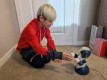
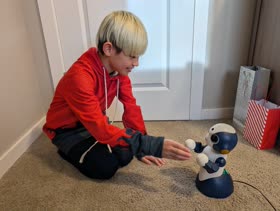
Social robots are increasingly marketed as play companions for children, but research has not established how these robots support play in real-world scenarios or whether their interactivity supports quality play. We are conducting an eight-week home study with children with and without disabilities to learn about the play experiences with an interactive robot versus a doll version of the same robot (a VStone Sota). We implemented interactive robot behaviors based on LUDI's categorization of play, incorporating social and cognitive dimensions of play to support children’s play in various developmental play stages. We measure play quality using standardized instruments, and along with qualitative assessments of children's engagement and interest through child-family interviews. This study investigates whether interacting with robotic toys supports children in developing play skills compared to non-robotic dolls. Our findings will establish baseline knowledge about child-robot play and can guide evidence-based design of play companions for children.
Video
Download the “I want Sota to be smarter!”: Investigating Children’s Play with Deployed Robots and Robot Dolls video file.
Publisher Link
https://dl.acm.org/doi/abs/10.1145/3776734.3794346
Citation
Raquel Thiessen, Minoo Dabiri Golchin, Samuel Barrett, Jacquie Ripat, and James Everett Young. 2026. “I want Sota to be smarter!”: Investigating Children’s Play with Deployed Robots and Robot Dolls. In Companion Proceedings of the 21st ACM/IEEE International Conference on Human-Robot Interaction (HRI Companion '26). Association for Computing Machinery, New York, NY, USA, 15–20. https://doi.org/10.1145/3776734.3794346
Bibtext Entry
@inproceedings{10.1145/3776734.3794346,
author = {Thiessen, Raquel and Dabiri Golchin, Minoo and Barrett, Samuel and Ripat, Jacquie and Young, James Everett},
title = {“I want Sota to be smarter!”: Investigating Children’s Play with Deployed Robots and Robot Dolls},
year = {2026},
isbn = {9798400723216},
publisher = {Association for Computing Machinery},
address = {New York, NY, USA},
url = {https://doi.org/10.1145/3776734.3794346},
doi = {10.1145/3776734.3794346},
abstract = {Social robots are increasingly marketed as play companions for children, but research has not established how these robots support play in real-world scenarios or whether their interactivity supports quality play. We are conducting an eight-week home study with children with and without disabilities to learn about the play experiences with an interactive robot versus a doll ver-sion of the same robot (a VStone Sota). We implemented interactive robot behaviors based on LUDI's categorization of play, incorporating social and cognitive dimensions of play to support children’s play in various developmental play stages. We measure play quality using standardized instruments, and along with qualitative assessments of children's engagement and interest through child-family interviews. This study investigates whether interacting with robotic toys supports children in developing play skills compared to non-robotic dolls. Our findings will establish baseline knowledge about child-robot play and can guide evidence-based design of interactive play companions for children.},
booktitle = {Companion Proceedings of the 21st ACM/IEEE International Conference on Human-Robot Interaction},
pages = {15–20},
numpages = {6},
keywords = {children, play, robots},
location = {Edinburgh, Scotland, UK},
series = {HRI Companion '26}
}
Authors

Raquel Thiessen
PhD Student
Minoo Dabiri
Postdoctoral Fellow
Sam Barrett
MSc Student
James E.Young
ProfessorAs well as: Jacquie Ripat